SEO vs GEO: What’s the Difference and Why It Matters in 2026?
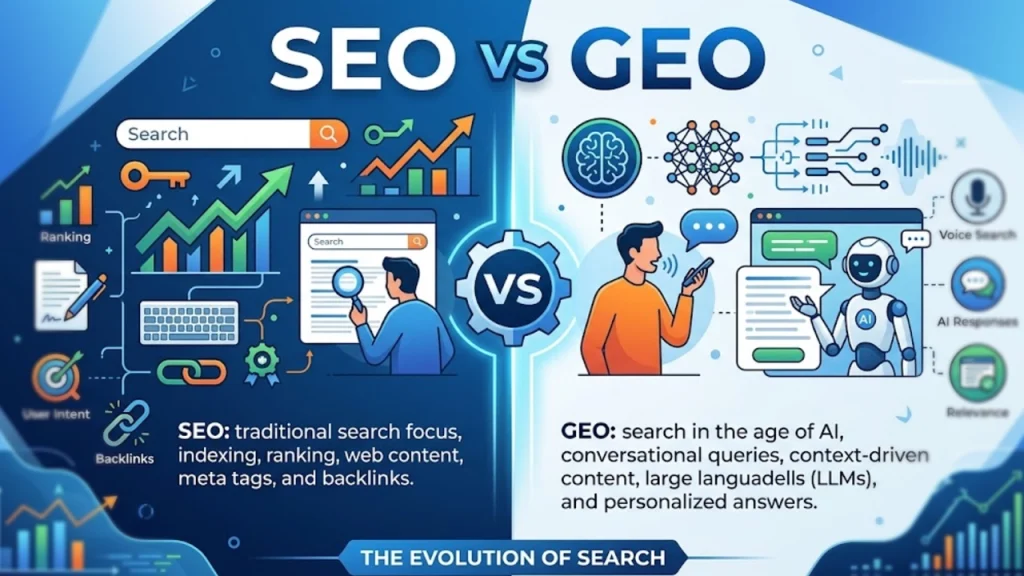
For more than two decades, SEO has been the foundation of online visibility. Businesses optimized websites, built backlinks, improved page speed, and created content to rank higher in search engines.
But in 2026, a new term is rapidly gaining attention: GEO.
You may have already seen marketers talking about “Generative Engine Optimization” and wondering whether it is simply another SEO buzzword. The truth is that GEO represents one of the biggest shifts in digital visibility since the birth of search engines.
While SEO focuses on helping websites rank in search results, GEO focuses on helping brands and websites appear inside AI-generated answers.
Understanding the difference between these two approaches is becoming essential for anyone who wants to remain visible online.
What Is SEO?
SEO, or Search Engine Optimization, is the process of improving a website so that it ranks higher in search engines such as Google and Bing.
The primary goal of SEO is simple :
When someone searches for a topic, your website appears among the results.
Traditional SEO includes activities such as:
- Keyword research
- Content optimization
- Internal linking
- Technical SEO
- Page speed improvements
- Mobile optimization
- Backlink building
- Structured data implementation
For years, SEO has been responsible for generating billions of visits across the web.
Even today, SEO remains one of the most effective digital marketing strategies available.
What Is GEO?
GEO stands for Generative Engine Optimization.
Instead of focusing on search result rankings, GEO focuses on increasing the likelihood that AI systems mention, cite, recommend, or reference your website and brand.
Examples of generative engines include:
- ChatGPT
- Gemini
- Claude
- Perplexity
- AI Mode in search engines
- AI-powered assistants and agents
When a user asks an AI assistant a question, they often receive a direct answer instead of a list of websites.
This creates an entirely new challenge.
If users never click a search result because they receive the answer directly from AI, how can your brand remain visible?
This is where GEO becomes important.
The Core Difference
The easiest way to understand the difference is this:
SEO helps users find your website.
GEO helps AI systems find and trust your information.
In traditional search, users browse multiple websites and decide which source to trust.
In generative search, AI systems often make that decision before the user ever sees a webpage.
As a result, websites must optimize not only for search engines but also for AI retrieval systems.
How SEO Works
Search engines primarily evaluate:
- Relevance
- Authority
- User experience
- Technical quality
- Link signals
If your page provides the best answer to a query and demonstrates sufficient authority, it may rank highly.
The ultimate objective is earning a click.
SEO success is often measured through:
- Rankings
- Organic traffic
- Click-through rate
- Search visibility
- Conversions
How GEO Works :
Generative engines evaluate different signals.
While many traditional SEO factors still matter, AI systems increasingly look for:
- Factual accuracy
- Brand reputation
- Entity recognition
- Content clarity
- Topical expertise
- Trustworthiness
- Cross-platform mentions
AI models are trained using enormous amounts of information collected across the internet.
They analyze patterns to determine which sources appear reliable.
A website frequently mentioned by experts, communities, publications, and trusted sources is more likely to become part of AI-generated responses.
Why Brand Mentions Matter More Than Ever
One of the most important GEO signals is brand recognition.
Search engines often rely heavily on backlinks.
AI systems increasingly rely on mentions.
For example, if your company is frequently discussed on :
- YouTube
- Industry blogs
- Online communities
- Review platforms
- News websites
AI systems gain stronger confidence that your brand is relevant and trustworthy.
This is why many companies are now investing in visibility beyond traditional SEO campaigns.
Can SEO Alone Still Work ?
Yes.
SEO remains incredibly valuable and continues to generate traffic.
However, relying exclusively on SEO may become increasingly risky.
Search results are changing.
AI Overviews, AI Mode, and AI assistants often answer questions directly without requiring users to visit a website.
This trend is expected to accelerate throughout 2027.
Businesses that combine SEO and GEO are positioning themselves for the future.
The Best Strategy: SEO + GEO
The smartest websites today do not choose between SEO and GEO.
They combine both.
Strong SEO helps search engines understand and rank content.
Strong GEO helps AI systems trust and reference that content.
Together, they create a powerful visibility strategy that works across both traditional search and AI-driven discovery platforms.
The Future of Digital Visibility
The internet is entering a new era.
For years, visibility meant ranking on the first page of search results.
Today, visibility increasingly means being included in AI-generated answers.
SEO is not disappearing.
Instead, GEO is emerging as an additional layer of optimization that works alongside traditional search strategies.
The websites that succeed in 2026 and beyond will be those that build authority, earn trust, create genuinely useful content, and establish strong brand recognition across the web.
In the future, the question will no longer be How do I rank higher?
It will increasingly become:
How do I become a source that both search engines and AI systems trust enough to recommend ?
More Articles:
- Website Algorithms in 2026 and 2027: What Really Matters for Rankings?
- Gemini Ranking Factors: What Really Helps Your Website Appear in Google Gemini?
- 14 SEO Trends for 2026: What Is Real, What Is Hype, and What Actually Helps AI Visibility
- Google May 2026 Core Update: What Changed, What Site Owners Should Do Next
- How to Get Your Brand Recommended by ChatGPT and Gemini
- How to Check If a Website Is Down: A Practical Guide for Users and Website Owners
- What Is Website Intelligence and Why Does It Matter for SEO?